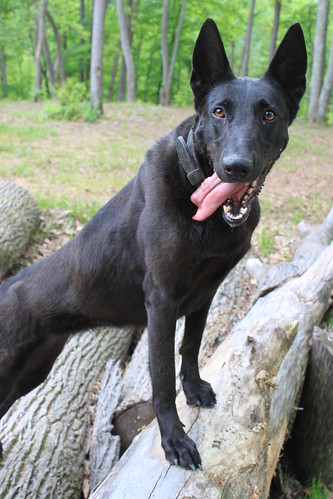
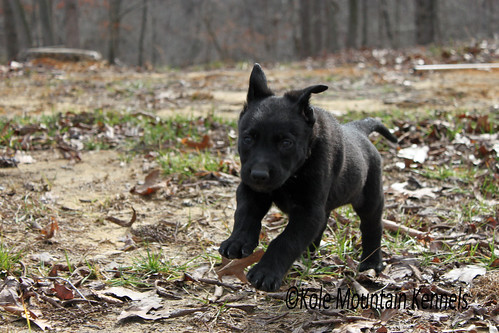
Christie M wrote:The way I understood it is the black is a totally separate allele set. So the dog would have the same BB/Bb/bb pairing that would produce fawn or brindle, but if the black gene is present it will be expressed regardless. So I would say that genetically, if they are BB but still black, I would consider that a black DS.
It was already said, but blac
K is noted as K.
Because B was taken by Brown. (I know, very confusing, right?)
Also note that I assume the question is about solid black dogs, lacking all brindle.

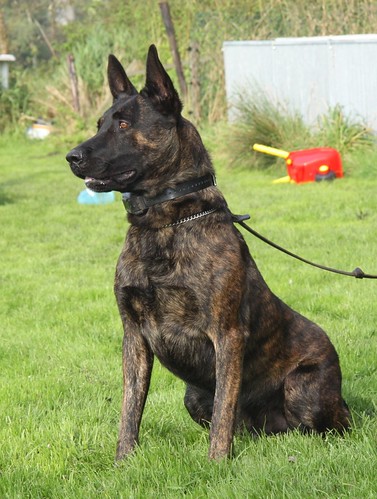
:Because there are DS's who appear very dark to the eye, but who are still brindle. In that case, you are totally right, they are still DS's, just in a dark dark shade. The standard says, subjectively, that "too much black" is not desired, but that aside.
Marjolein wrote:It has nothing to do with the K locus, it's the A locus, as you can also see in the chart Asheley refers to.
I know what you mean, but it is confusing like this.

Yes, Black is related to the K locus.
It is the first dominant allele on that Locus, KB =black. Next allele on the locus is Kbr, in wich the black shows in some area's of the body, but not in others. The area's where it does not show will show the A locus coming through. So the red 'stripes' are actually the 'under color' caused by the A locus.
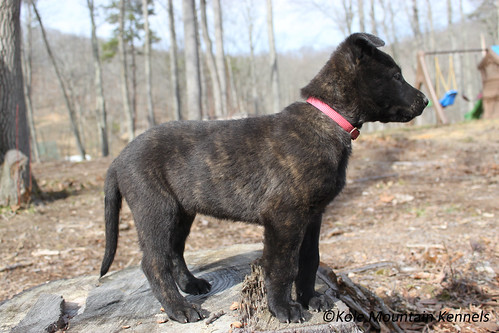
If you have a dog that is brindle (Kbr/Kbr or Kbr/Ky) and for A locus had Ay/Ay (or Ay/a or Ay/At, very unlikely for DS I think) the dog wil look like the DS we know, brindle on a (all shades of) yellow underground. Now if a dog has a/a (recessive black) the brindle will still be there, but as brindle is black, on a black background...you will see...only black!
Yes,
in theory you could get a recessive black DS. BUT. I think it is theory only. There are very very few black malinois born in FCI lines that are recessive black. I have heard of only one or two in the past 25 years. (but If someone knows of any, I would LOVE to hear who/where) The black malinois in KNPV is, like Selena already said, a KB product that comes from a groenendealer=Belgian Sheepdog in the 70's. (andor vd ijsselvloed) Those dogs are KB, and while they can hide Kbr as the second allele on that K locus**, they will also most likely produce 50% solid black dogs with a brindle or fawn partner.
**Of course, I know you all know that for every trait, we possess two copies, one given by each parent. One will display (the dominant one) and one will hide (the recessive one) Both copies can be identical, and then we say that someone is homozygous for a trait. If the copies are different, we say that someone is hetrozygous.
It is impossible to have a dominant black (KB) dog from two brindle parents because any dog carrying this gene IS in fact black, the parents could never show brindle

You got it!

Dominant traits can hide recessive traits. But recessive traits cannot hide dominant ones.

So if (KB) black is dominant over brindle, two brindle dogs will not be able to produce a black.
Unless....(we are talking about recessive black, a totally recessive trait on another (A) locus, but let's not go there, because there is virtually no recessive black in either FCI DS's nor KNPV DS's)
 Honestly, the ones I am seeing look GSD to me but of course that just starts an argument. So I thought I would get a bit more educated by those who know. Too me DS are BRINDLE. Yes, various color, shades of brindle but brindle. I don't see Black as a standard acceptable color but is it genetically possible?


 Yup. You are right.